Twenty-Five Thousand People Drew Something. What Kind of Object Is That?
In 2019, Steve McQueen photographed 76,000 seven- and eight-year-olds across London and hung the result at Tate Britain as a single work. Year 3 was a collective portrait of an entire school year of a city, and its force came from something no individual commission can manufacture: scale that is also specificity. Seventy-six thousand children, each one particular, not one of them a symbol.
We have been circling that work because we ended up with something structurally similar by accident. Twenty-five thousand people drew on a canvas inside an installation in Los Angeles, anonymously, over the run of an exhibit.
We are not claiming ours is an artwork of the same order. McQueen's was authored, conceived, and executed with intent. Ours was a canvas that people used. But it raises a question we think is genuinely open, and that question is the subject here.
The Two Kinds of Participation
Worth separating, because they are conflated constantly and they produce very different objects.
Participation as material. An artist sets the terms and the public supplies the content, which the artist then shapes. Year 3 works this way, as does most of what gets called socially engaged practice. Authorship stays singular. Scale is the medium.
Participation as accumulation. No author, no shaping, no editorial pass. Something is left open and people use it. Graffiti walls, guest books, the Post-it walls that appear in subway stations after difficult events, the layered drawings on a pub toilet door.
The second kind draws far less institutional attention, because it is harder to attribute, harder to exhibit, and much harder to acquire. It also produces something the first kind cannot: an unedited record. Nobody selected for quality or representativeness, which means the ordinary and the terrible are present in their true proportions.
That is either a serious limitation or the entire value, depending on what you think the object is for.
What Our Canvas Actually Showed
Three observations, offered as observations rather than findings.
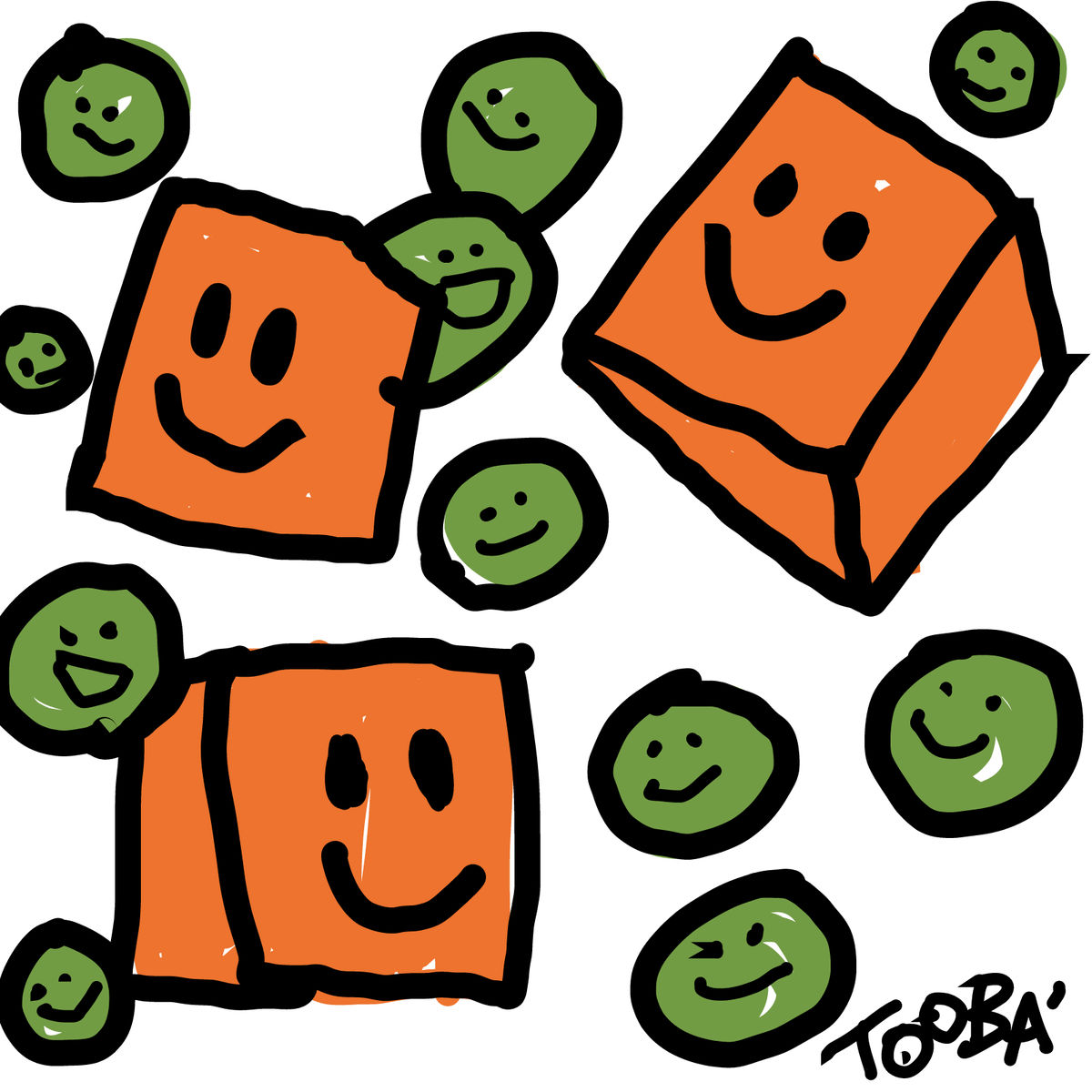
Almost nothing was corrected. Across 25,000 drawings, mistakes were absorbed rather than avoided. A slipped line became hair, an oversized circle became an eye. Whatever anonymity removes, it appears to remove the incentive to protect one's reputation as a drawer.
People drew responses to each other. Consistently, without instruction, with no mechanism prompting it. Someone draws a figure, the next person draws a second figure facing it. A door gets an interior. A visual joke gets a punchline from a stranger who will never meet the person who set it up. A shared surface reads as addressed to whoever comes next.
The subject matter was not what gets posted publicly. Faces overwhelmingly, then dense repetitive mark-making, then words in place of images.
The Question We Cannot Answer
Here is what we think is genuinely unresolved, and where we would rather ask than assert.
An accumulated participatory record is not a work, not quite a document, and not really an archive in the conventional sense. It has no author to credit, no edition, no discrete boundaries, and no obvious conservation object. It is also, self-evidently, the most direct trace of a public that any institution could hold.
Museums have spent two decades getting better at audience participation as programming. What stays unsettled is participation as collection: whether the residue of a participatory event is something an institution should keep, how it would be catalogued when nobody signed it, and what it means to conserve a thing whose value is that it was never curated.
We do not have a position on this. We have 25,000 drawings and a genuine question.
The Archive Is Open
The full set is public and free to look through, no account needed.
If you work in a museum, a gallery, or a research context and this is useful to you, it is available. contact us We are more interested in the material being looked at than in owning the conversation about it.